


Inspection of steel wire ropes
Steel wire rope will be worn during use and needs to be inspected regularly.
Daily visual inspection
At least the intended working section of rope for that day shall be observed with the objective of detecting any deterioration of mechanical damage. This shall include the attachment points of the rope to the crane, that the rope spools correctly and runs smoothly over sheaves.
Any noticeable changes shall be reported, and any damage must be inspected by an expert.
Periodic inspection
Steel wire rope shall be inspected at least every 12 months, or more frequently acc. to local legislation by a competent person. Records of such examinations should be maintained.
Steel wire rope on winches and cranes should be inspected regularly acc. to ISO 4309.
Steel wire rope on elevators should be inspected regularly acc. to ISO 4309 and ISO 4344.
Steel wire rope for cableway installations designed to carry persons should be inspected acc. to EN 12927.
Inspection
When inspecting the steel wire, special attention must be paid to the parts of the wire that are empirically exposed to wear and damage.
Wear, broken wires, distortion and corrosion are more common visible signs of deterioration.
Wear is a normal feature of rope service and the correct rope construction ensures that it remains a secondary aspect of deterioration. Correct lubrication of the rope may help reduce outer and inner-wear.
Broken wires are normal features of wire rope service towards the end of the rope's life, resulting from bending fatigue and wear. The local break up of wires may indicate some mechanical fault in the equipment. Correct lubrication in service will increase fatigue performance.
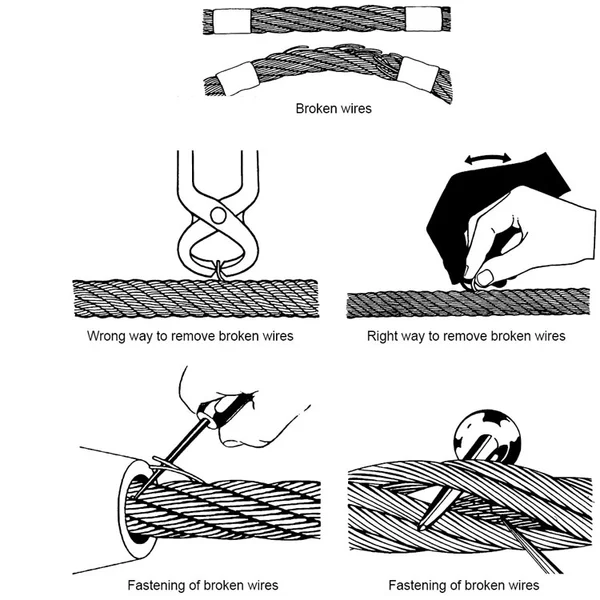
Individual broken wires shall be attended to by removing the wire, see figure.
 WARNING! Do not cut the wire, bend it until it breaks close to the inside of the strand. This reduces the risk for ends of wires sticking out of the rope.
Distortions are usually a result of mechanical damage, and if severe, can considerably affect the wire rope strength.
Corrosion of both outer and inner wires indicates insufficient lubrication. Pitting on the external wire surface can result in wire breaks. Inner corrosion occurs in some environments when lubrication is inadequate or of unsuitable type. Reduction in wire rope diameter will frequently guide the observer to this condition, but confirmation can only be made by inner examination of the wire rope.
Steel wire rope discards
Steel wire ropes must be discarded according to current standards for the equipment or the manufacturer's recommendations.
Disposal determination must be performed by a competent person with knowledge of applicable norms and standards. WARNING! Inadequate inspection/disposal can lead to serious injuries.
Typical examples of damage and wear on steel wire ropes
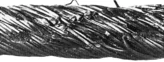 |
| Mechanical damage due to rope movement over sharp edge projection whilst under load. |
 |
Narrow path of wear resulting in fatigue fractures, caused by working |
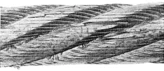 |
Severe wear, associated with high tread pressure. |
 |
Corrosion of severe degree caused by immersion |
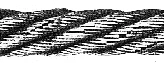 |
Typical wire fractures as a result of bend fatigue. |
 |
Break up of the steel core resulting from higt stress application. |
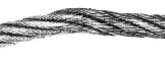 |
Typical exampel of localised wear and deformation created |
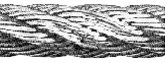 |
| Localised wear due to abrasion on supporting structure. Vibration of rope between drum and jib head sheave. |
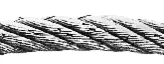 |
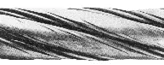
Two parallel paths of broken wires indicative of bending |
 |
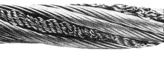
Severe wear in Langs Lay, caused by abrasion at cross-over |
 |
|
 |
Wire fractures at the strand, or core interface, as distict from "crown" |
.") |
Strand core protrusion as a result of torsional unbalance created |
 |
Multi strand rope "bird caged" due to torsional unbalance. |
Discard values for visible broken wires occuring in single-layer and parallel-closed ropes (acc. to ISO 4309-2010)
over a length of 6d and 30d
| Rope category number RCN | Total number of load-bearing wires in the outer layer of strands in the rope (a) n | Number of visible broken outer wires (b) | |||||
| Sections of rope working in steel sheaves and/or spooling on a single-layer drum (wire breaks randomly distributed) | Sections of rope spooling on a multi-layer drum (c) | ||||||
| Classes M1 to M4 or class unknown (d) | All classes | ||||||
| Ordinary lay | Lang lay | Ordinary and Lang lay | |||||
| Over a length of 6d (e) | Over a length of 30d (e) | Over a length of 6d (e) | Over a length of 30d (e) | Over a length of 6d (e) | Over a length of 30d (e) | ||
| 1 | n ≤ 50 | 2 | 4 | 1 | 2 | 4 | 8 |
| 2 | 51 ≤ n ≤ 75 | 3 | 6 | 2 | 3 | 6 | 12 |
| 3 | 76 ≤ n ≤ 100 | 4 | 8 | 2 | 4 | 8 | 16 |
| 4 | 101 ≤ n ≤ 120 | 5 | 10 | 2 | 5 | 10 | 20 |
| 5 | 121 ≤ n ≤ 140 | 6 | 11 | 3 | 6 | 12 | 22 |
| 6 | 141 ≤ n ≤ 160 | 6 | 13 | 3 | 6 | 12 | 26 |
| 7 | 161 ≤ n ≤ 180 | 7 | 14 | 4 | 7 | 14 | 28 |
| 8 | 181 ≤ n ≤ 200 | 8 | 16 | 4 | 8 | 16 | 32 |
| 9 | 201 ≤ n ≤ 220 | 9 | 18 | 4 | 9 | 18 | 36 |
| 10 | 221 ≤ n ≤ 240 | 10 | 19 | 5 | 10 | 20 | 38 |
| 11 | 241 ≤ n ≤ 260 | 10 | 21 | 5 | 10 | 20 | 42 |
| 12 | 261 ≤ n ≤ 280 | 11 | 22 | 6 | 11 | 22 | 44 |
| 13 | 281 ≤ n ≤ 300 | 12 | 24 | 6 | 12 | 24 | 48 |
| n > 300 | 0,04 x n | 0,08 x n | 0,02 x n | 0,04 x n | 0,08 x n | 0,16 x n |
Note: Ropes having outer strands of Seale construction where the number of wires in each strand is 19 or less (e.g. 6x19 Seale) are placed in this table two rows above that row in which the construction would normally be placed based on the number of load bearing wires in the outer layer of strands
(a) For the purposes of this International Standard, filler wires are not regarded as load-bearing wires and are not included in the values of n.
(b) A broken wire has two ends (counted as one wire).
(c) The values apply to deterioration that occurs at the cross-over zones and interference between wraps due to fleet angle effects (and not to those sections of rope which only work in sheaves and do not spool on the drum).
(d) Twice the number of broken wires listed may be applied to ropes on mechanisms whose classification is known to be M5 to M8.
(e) d = nominal diameter of rope.
Discard values for visible broken wires occuring in rotation-resistant steel wire ropes (acc. to ISO 4309-2010)
over a length of 6d and 30d
| Rope category number RCN | Total number of load-bearing wires in the outer layer of strands in the rope (a) n | Number of visible broken outer wires (b) | |||
| Sections of rope working in steel sheaves and/or spooling on a single-layer drum (wire breaks randomly distributed) | Sections of rope spooling on a multi-layer drum (c) | ||||
| Over a length of 6d (d) | Over a length of 30d (d) | Over a length of 6d (d) | Over a length of 30d (d) | ||
| 21 | 4 strands n ≤ 100 | 2 | 4 | 2 | 4 |
| 22 | 3 or 4 strands n ≤ 100 | 2 | 4 | 4 | 8 |
| At least 11 outer strands | |||||
| 23-1 | 71 ≤ n ≤ 100 | 2 | 4 | 4 | 8 |
| 23-2 | 101 ≤ n ≤ 120 | 3 | 5 | 5 | 10 |
| 23-3 | 121 ≤ n ≤ 140 | 3 | 5 | 6 | 11 |
| 24 | 141 ≤ n ≤ 160 | 3 | 6 | 6 | 13 |
| 25 | 161 ≤ n ≤ 180 | 4 | 7 | 7 | 14 |
| 26 | 181 ≤ n ≤ 200 | 4 | 8 | 8 | 16 |
| 27 | 201 ≤ n ≤ 220 | 4 | 9 | 9 | 18 |
| 28 | 221 ≤ n ≤ 240 | 5 | 10 | 10 | 19 |
| 29 | 241 ≤ n ≤ 260 | 5 | 10 | 10 | 21 |
| 30 | 261 ≤ n ≤ 280 | 6 | 11 | 11 | 22 |
| 31 | 281 ≤ n ≤ 300 | 6 | 12 | 12 | 24 |
| n > 300 | 6 | 12 | 12 | 24 |
Note: Ropes having outer strands of Seale construction where the number of wires in each strand is 19 or less (e.g. 18x9 Seale – WSC) are placed in this table two rows above that row in which the construction would normally be placed based on the number of wires in the outer layer of strands.
(a) For the purposes of this International Standard, filler wires are not regarded as load-bearing wires and are not included in the values of n.
(b) A broken wire has two ends.
(c) The values apply to deterioration that occurs at the cross-over zones and interference between wraps due to fleet angle effects (and not to those sections of rope that only work in sheaves and do not spool on the drum).
(d) d = nominal diameter of rope.


 Contact us
If you have any questions, please send us a message and we will be happy to help.


See the webinar "Wire rope inspection"
In the webinar, you will get an insight into what to keep an eye on with your steel wire ropes
Do you want to know more about steel wire rope?
Then read the article "Technical description steel wire rope" which describes the wire from rod to rope.
Corrosion or rust on steel wire rope
There are several levels of corrosion on steel wires. Please take a look here at which ones and what they mean for the continued use of the wire.


