


What type of cargo securing should I choose for my goods?
Cargo securing is fundamentally about ensuring that cargo does not move during transport, whether by truck, trailer, or ship. During driving and sailing, the cargo is affected by braking, acceleration, uneven transport, sea swell, impact, and vibrations. Without proper securing, the cargo can shift, tip over, or, in the worst case, fall off, with serious consequences for people, equipment, and the cargo itself. At the same time, correct load securing is a legal requirement and a prerequisite for complying with applicable standards and guidelines.
When should goods be secured?
In practice, cargo needs to be secured during transport. Only if the cargo is tightly packed in a container or completely secured against solid headboards, the front wall, and bulkheads can additional securing, in some cases, be omitted. In day-to-day operations, however, most types of cargo will require securing, both on the road and at sea.
Effective load securing is based on a few simple principles. Friction is one of the most important factors: the higher the friction between the cargo and the loading platform, the lower the risk of the cargo sliding. Here, the choice of underlay, such as anti-slip mats, plays a major role.
Load securing can be carried out by friction lashing, where tension mainly increases friction, or by direct lashing, where the cargo is connected directly to the vehicle or ship – often a combination is used, especially for heavy cargo. The choice of method and equipment depends on the weight, shape, surface, centre of gravity, distribution on the platform, type of transport, and expected loads. Common to all is that equipment must always be suitable for the task, correctly marked and in good condition, and that the securing is done in accordance with applicable calculation rules and the manufacturer’s instructions
Web lashing (lashing with straps)
Web lashing is carried out using textile lashing straps, typically polyester. The straps can be used both for tensioning over the cargo and for certain types of direct lashing. They are light, flexible, and easy to handle, whether on a distribution truck, a trailer, or when securing cargo on a ship.
The biggest advantage of web lashing is that it is gentle on the cargo. The straps are well-suited for cargo with painted, lacquered, or sensitive surfaces; for pallets, boxes, building materials, machines without sharp edges, and many types of general piece goods. Their low dead weight makes them comfortable for drivers and crew to work with, and they can quickly be thrown over a load and tensioned.
Web lashing, however, has its limitations. The strength per individual lashing is typically lower than with chain lashing, and the straps are sensitive to sharp edges, wear, chemicals, and high temperatures. We always recommend using edge protection when straps are led over edges. Straps, hooks, and tensioning devices should be visually inspected regularly by the user and immediately removed from service if they show visible damage or the labels are not legible. In addition, the lashing equipment must be inspected by a competent person at least once a year.
Web lashing is therefore an obvious choice for securing light-to-medium-heavy cargo on trucks, trailers, or ships, where gentle handling of surfaces is required, quick handling is needed, and the environment is not too harsh or hot. |
Lashing with chains
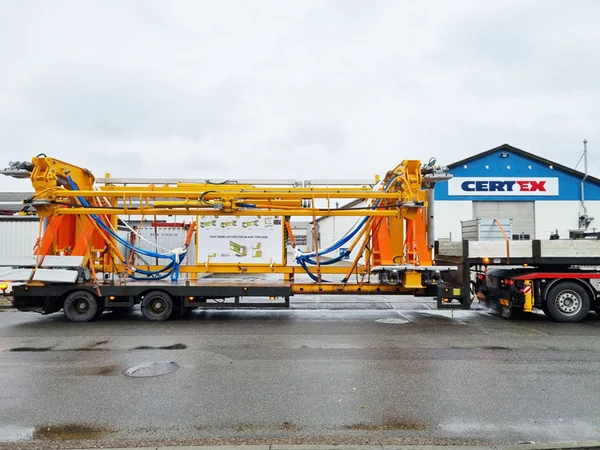
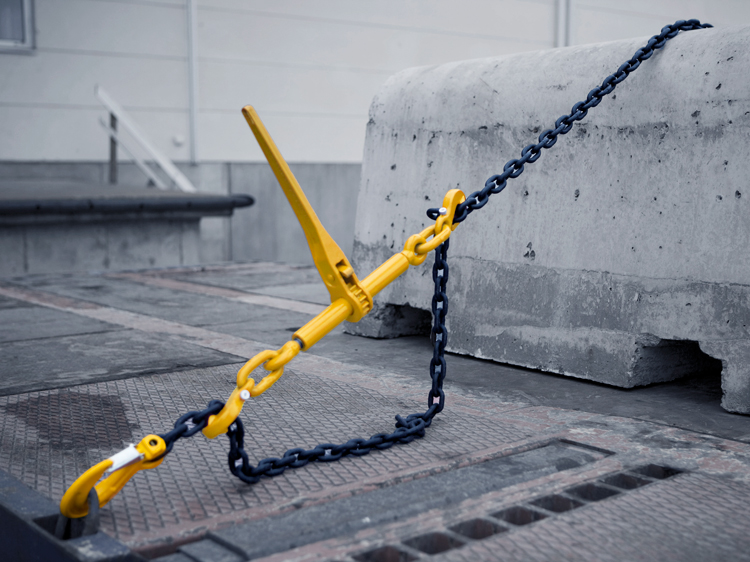
Chain lashing is carried out using lashing chains and load binders and is particularly used when handling heavy or very heavy cargo, or when transport loads are expected to be high. The chains have very high strength and are particularly suitable for direct lashing, where the cargo is connected to lashing or lifting points on, for example, machines, steel and concrete elements, or other heavy equipment. This applies both to road transport and to securing heavy cargo on board a ship.
Chain lashing is robust, withstands high temperatures, sparks, and harsh environments, and is less sensitive to sharp edges than web lashings. On the other hand, chains are heavy and more physically demanding to work with (unless you choose a synthetic lashing chain), and they can damage sensitive surfaces if edge protection or special protective elements are not used. In addition, chain systems are typically more expensive to purchase and may require a bit more time to install and adjust correctly.
Chain lashing is the natural choice for construction machinery, agricultural machinery, forklifts, heavy steel structures, coils, and other heavy items where high strength and direct securing is required – both on the road and at sea. |
When to choose web lashing – and when to choose chain lashing?
The choice between web lashing and chain lashing depends first and foremost on the cargo's weight and surface area, as well as the loads expected during transport. Web lashing is typically best when the cargo has a sensitive or visually appealing surface, when the cargo weight ranges from light to heavy, when the work needs to be done quickly, and when the ergonomic strain on the operator should be reduced. This is the case, for example, with general palletized goods, building materials, machines with delicate surfaces, and mixed loads on trucks and trailers.
Chain lashing is preferable when the cargo is heavy or very heavy, when transporting machinery, steel, and concrete elements, or when the transport takes place under high-load conditions, such as rough terrain, heavy sea swell, or frequent load changes. In these situations, the high strength and robustness of chains provide the necessary safety.
In many situations, the best solution is a combination: web lashing can be used to create friction and bundle the cargo, while chain lashing can be used to secure the heaviest or most critical units directly. In this way, you achieve both gentle handling of the cargo and a high level of safety – regardless of whether the transport takes place by truck, trailer, or ship.

Web Lashing Powertex Trucker r-PET
- This lashing is part of Lifting Solution Group's Aspire Range™


 Do you have any questions?
If you have any questions, please send us a message and we will be happy to help.
Learn more about load securing
and what you should check.
There is important information on the lashing labels
The blue label on a POWERTEX web lashing contains essential information for its correct use. In this article, we will go through point by point what each piece of information means.


