


- how they affect the service life of a steel wire rope
A steel wire rope is not only worn by the load during the lift itself. Unnecessary wear, deformation, and reduced service life often occur due to the components the rope interacts with – especially wire rope drums, sheaves, and the fleet angle.
Even a correctly selected steel wire rope can have a significantly reduced service life if it runs over worn sheaves, is wound incorrectly onto the drum, or operates with too large an angle between the drum and sheave. The entire system should therefore be assessed when a rope is installed, replaced, or inspected.
Why is the interaction between the wire rope and equipment important
Steel wire rope is a moving component constantly exposed to bending, pressure, friction, and tension. Every time the rope passes over a sheave or is wound onto a drum, the individual wires and strands are affected.
If sheaves, drums, or entry angles are not suited to the rope, this can lead to:
- Increased wear on the outer wires of the rope
- Wire breaks
- Pressure damage and flattening
- Poor winding on the drum
- Twisting and rotation problems
- Reduced breaking strength over time
- Shorter service life
- Increased risk of downtime
When assessing the condition of a steel wire rope, you should therefore not only look at the rope itself, but also at the equipment it runs through.
The wire rope drum – correct winding is essential
The function of the wire rope drum is to store and guide the rope during operation. Correct drum function ensures that the rope is wound evenly and without unnecessary stress.
If the rope does not wind correctly, point loads may occur. This can lead to deformation, flattening, and damaged strands. Correct drum configuration and rope guidance are particularly important with multi-layer spooling, as the rope is exposed to high contact pressure between the layers.
Spooling onto the drum
When spooling, the rope must be wound tightly, evenly, and in a controlled manner. Loose spooling may cause the rope to be pressed down into the underlying layers under load. This can damage the rope and make it difficult to unwind correctly.
Especially when installing a new steel wire rope, it is important that the first spooling is carried out with sufficient tension. Proper running-in helps the rope settle correctly on the drum and reduces the risk of irregular winding.
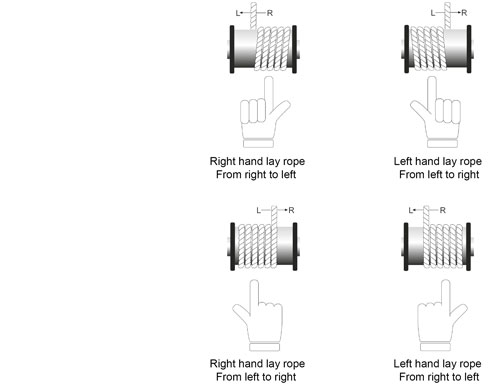
Wire rope drum - the correct coiling direction
The rotation direction and the attachment point of the rope determines whether right or left hand lay rope should be used. To determine
the correct rope the following rule should be followed.
A simple rule is the following:
- Right thread groove on the drum - left-hand lay rope
- Left thread groove on the drum - right hand lay rope
 WARNING! Incorrect choice of lay may affect rope performance.
The coiling direction in the figures applies to both smooth drums and drums with wire grooves..
Pay attention to the drum diameter
If the drum diameter is too small, the rope is bent more sharply than it is designed for. This increases bending fatigue and can significantly shorten the service life of the rope. The drum diameter should therefore always be matched to the rope’s construction, diameter and application.
As a rule of thumb: the larger the drum and sheave diameter in relation to the rope diameter, the gentler the load on the rope.
Wire rope sheaves – small defects can cause major wear
Wire rope sheaves guide the rope and change its direction. They are therefore among the most demanding contact points in a wire rope system. The sheave groove, diameter and general condition have a major impact on how the rope wears.
Before installing a new wire, check the wire sheave tracks for wear and sharp edges. Measure the groove diameter with a radius gauge and check the general condition of the groove.
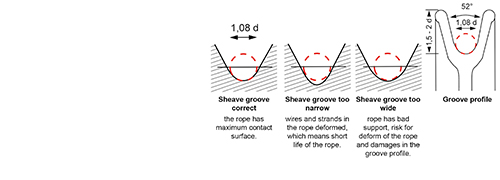
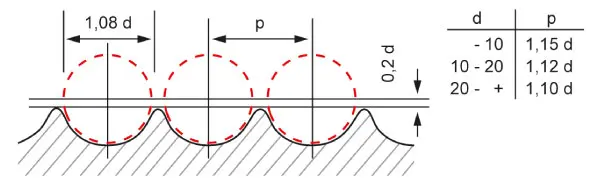
Groove diameter shall be nominal rope diameter +8% to +14% (0,54 x d to 0,57 x d).
WARNING! Worn wire rope sheaves should be replaced/repaired.
Signs of problems with wire rope sheaves
During inspection, look for:
- Worn or sharp grooves
- Grooves that are too narrow or too wide
- Rust, notches or uneven surfaces
- Poor sheave rotation
- Defective bearings
- Misaligned sheaves
- Lack of bearing lubrication
- Signs that the rope is riding up the flange
A sheave that does not rotate freely can create severe friction. This may cause rapid heating, surface wear, and damage to the rope. Similarly, a misaligned sheave or incorrect entry angle can force the rope against the sheave flange, causing localised wear.
The sheave groove must fit the rope
A wire rope sheave must support the rope correctly in the groove. If the groove is too narrow, the rope is compressed. If the groove is too wide, the rope receives too little support and may move sideways. Both can lead to increased wear and deformation.
A correct groove supports the rope without pinching it. As a general principle, the rope should contact the sheave in a way that distributes the pressure evenly over an appropriate part of the rope’s circumference.
Wire rope grooves should support the rope along approx. 1/3 of its circumference. CERTEX Danmark recommends a groove diameter of 1,08 x d, where d = nominal wire rope diameter.
Drum - multiple layers
Multiple layers of wire on the drum can cause deformation (flattening, distortio etc.) on the lower layers if the wrong rope construction is used and/or by incorrect winding.

Fleet angle
The fleet angle is the angle between the rope’s running direction and the ideal straight line onto the drum or sheave. The angle occurs where the rope enters a drum or sheave and first comes into contact with the rope groove or flange.
When the rope passes over a sheave, it will not only roll but also slide down the flange until it lies correctly at the bottom of the groove. This movement can cause the rope to rotate around its own axis. As a result, twist may be introduced into or removed from the rope, which can either shorten or lengthen the rope and affect its stability.
If the fleet angle becomes too large, the rope will try to pull sideways. This can cause severe wear against drum flanges, sheave flanges or adjacent rope layers on the drum. At the same time, the risk of poor winding, twisting problems and damage to the rope construction increases .
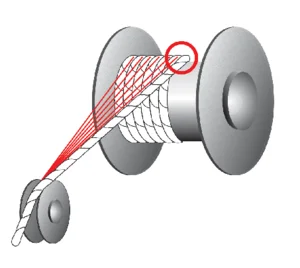
Rotation-resistant and semi-rotation-resistant ropes are particularly sensitive to incorrect rope guidance. As the fleet angle increases, the occurrence of rotation also increases.
As a rule of thumb, the fleet angle should not exceed:
- 2° for rotation-resistant ropes
- 4° for single-layer ropes
Although an excessive fleet angle is often the biggest challenge, an angle that is too small or unsuitable can also cause problems – especially on drums without guide grooves. In such cases, the rope may have difficulty moving correctly from layer to layer, which can result in uneven winding.
It is therefore not only about minimising the fleet angle, but about ensuring that the rope is guided correctly and in a controlled manner throughout the entire working range.
Positioning of sheaves and drum
The fleet angle is affected by the distance between the drum and the first sheave, as well as the position of the sheave in relation to the width of the drum.
In general:
- A greater distance between the drum and the first sheave gives a smaller angle
- Correct centering reduces sideways loading
- Incorrect positioning can cause wear against flanges
- Multi-layer spooling requires special attention
During installation, check that the rope runs freely and naturally, without being forced sideways onto the drum or down into the sheave groove.
The interaction between drum, sheave and rope type
Not all steel wire ropes react in the same way to the same operating conditions. A compacted rope, a low-rotation rope and a standard 6-strand rope may have different requirements for drums, sheaves and handling. The choice of the correct steel wire rope should therefore always be considered in relation to the machine or installation in which the rope will operate.
Typical signs of incorrect interaction in the wire rope system
If a steel wire rope has a shorter service life than expected, the cause can often be found in the surrounding equipment.
Look out for;:
- One-sided wear on the rope
- Repeated wire breaks in the same place
- Flattened areas
- Birdcaging or deformation
- Twisting in the rope
- Uneven spooling
- Marks from drum flanges
- The rope “wandering” incorrectly on the drum
- Unusual noise or vibration during operation
- Visible wear in sheave grooves
These signs should lead to a closer inspection of the entire system – not just the rope.


 Contact us
If you have any questions, please send us a message and we will be happy to help.


Choosing steel wire rope
Guide to help when choosing your steel wire rope.
Installation of steel wire rope
Learn how to unwind your new steel wire rope from the packaging, and how to "run in" the rope correctly before use.
Wire rope diameter and tolerances
How to measure a wire's diameter correctly. Read here how, and see wire tolerances for steel wire


